 In the 2015 Operational Budget, ESSB 6052 Sec 501 (34) directed OSPI to convene a work group to recommend comprehensive benchmarks for developmentally appropriate interpersonal and decision-making knowledge and skills of social and emotional learning for grades kindergarten through high school that build upon what is being done in early learning. (Here is the legislation: http://lawfilesext.leg.wa.gov/biennium/2015-16/Pdf/Bills/Senate%20Passed%20Legislature/6052-S.PL.pdf)
The workgroup will submit recommendations to the education committees of the legislature, and the office of the governor by October 1, 2016.
Here are their members:
| Name | Representing | Role |
| Veronica Santangelo | Department of Early Learning | ECLIPSE Program Administrator |
| Ron Hertel | Student Support, OSPI | Program Supervisor Student Mental Health and Wellbeing |
| Marissa Rathbone | Teaching and Learning, OSPI | Health and Physical Education Program Supervisor |
| Carrie Basas | Office of the Education Ombuds | Director, Office of the Education Ombuds |
| Dr. Todd Herrenkohl | Higher Education Faculty Member | Professor and Co-Director 3DL Partnership, University of Washington |
| Lyon Terry | Washington Education Association | National Board Certified Teacher, Seattle School District |
| Susanne Beauchaine | Washington Association of School Administrators | Executive Director of Student Services, Steilacoom Historical School District |
| Annemarie Hutson | Washington Association of School Psychologists | National Certified School Psychologist |
| Julie Sullenszino | Washington Association of School Social Workers | School Social Worker, Bethel School District |
| Juanita Hill | Washington School Counselor Association | School Counselor |
| Sherry Krainick | School Parent Organization | Learning Assessment Coordinator, WA PTA |
| Sarah Butcher | Stakeholder Group | Co-Founder, SEL for Washington |
| Mick Miller | Regional Education Network | Assistant Superintendent, NEWESD 101 |
| Brent Capatch | Washington Workforce | Youth Coordinator, Workforce Central |
| Dr. John Glenewinkel | Rural Schools | Superintendent, Republic School District |
| Senator John McCoy | EOGOAC | Co-chair/Washington State Senator, 38th District – Tulalip |
| TBD | Mental Health Counselors |
Member thoughts: As usual we see members of various agencies, administrators and the PTA but not a single member of the public. This appears to be just another example of people with agenda’s creating policy and making recommendations without the input of parents and taxpayers.
The SELB Workgroup developed a Stakeholder and Feedback plan in order to receive input from key stakeholders on the work group’s draft Social and Emotional Learning Benchmarks for K-12 students in Washington state.
- View the Stakeholder Engagement Feedback Plan
- Host a Focus Group in your area
- Provide input on the benchmarks
Let’s take a look at the survey (you see it if you click the “provide input on the benchmarks”):
Observation #1: There are six (6) Standards consisting of Part A, B and C. Standard #6 isn’t finished. Here’s 1A:
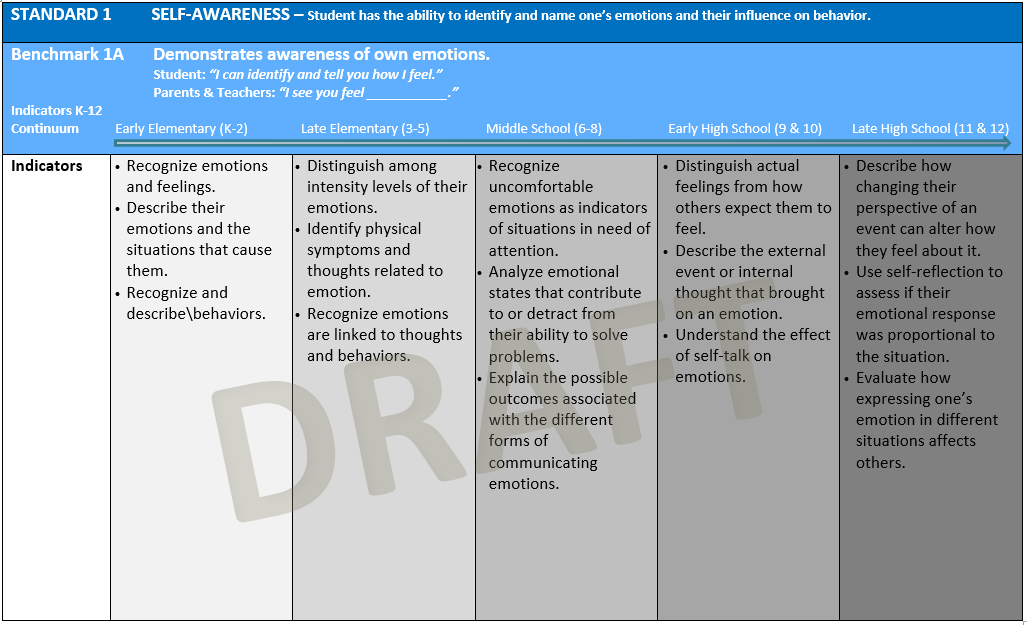
Observation #2: This entire system reads like performance review standards with details of actions and behaviors that are then used to “grade” how well the student/adult have done at their job.
Observation #3: It’s not clear if this is intended to be used across the board on every student every day, once a year or never. If it’s used broadly it’s going to take a LOT of time and money. The people doing the evaluations will be trained (?) and will interpret and apply the same measures?
Observation #4: This could generate a LOT of data that then needs to be entered in a database which will, at some point in time, be “hacked”. This will require some sort of analysis system to determine whether one specific standard not being met is problematic or some mix? When the analysis says action needs to be taken what then happens and what if the intervention isn’t successful?
Question #1: What is the intent of all this?
Question #2: What’s this all going to cost (time and money)?
Question #3: How will “success” be judged?
Question #4: Aren’t these things taught at home and learned in life? Do we need someone sitting in an ivory tower “training” children how to think, feel and act? Is the “State” now the parent? Isn’t this an indoctrination under the guise of helping children?
Question #5: What if the kids and parents tell those in charge to take a flying leap? Are they punished or is their record used to “re-direct” them? Will they be required to use medications or undergo “counseling” if their behavior deviates from the “Collective”? (BORG)
Summary Thoughts:
- Did the people on this committee grow up watching Star Trek and fall in love with Mr. Spock?
- Who has decided that the community should set all the rules for everyone’s conduct, actions and behaviors?
- Why is this necessary? Do we need good, quiet, compliant children who all think alike, act alike and march to the same drum?
- How many children need intervention? If it’s actually small why do this for everyone and if it’s not for everyone how do they decide who needs intervention?
Leave a Reply
You must be logged in to post a comment.